Friday, December 4, 2015

The Awakening Post #4


As stated in the article, the Creoles saw themselves as urban and sophisticated and a refined style of European living was their aspiration. The Creole community had a strong impact on Mrs. Pontellier attitudes. Mrs. Pontellier felt as though she was an outsider because she was not originally from the Creole community, and Mrs. Pontellier’s feelings proved correct when Mrs. Ratignolle said “She is not one of us; she is not like us.”(Chopin 64) 

Perhaps Mrs. Pontellier’s sprouting feelings of anger and oppression were not caused by her marriage with Leonce, but due to the fact she is looked down upon in a community that is newer to her.  A person can only take being ignored or disrespected for so long before they will feel frustrated and upset.  Mrs. Pontellier begins to dislike Leonce because he is her direct link to the Creole community. If she unlinks herself from Leonce, then she will not have to be near the people that solicit her negative emotions. Her feeling of discrimination could be the reason that Mrs. Pontellier attached herself to Robert. Even though Robert was popular throughout the Creole community, he still treated Mrs. Pontellier how he treats others, and eventually he even feel in love with her. Robert shows how he is different from other members of the Creole society by saying “I hope she has discernment enough to find in me something besides the blagueur. If I thought there was any doubt- “(Chopin 64) Robert’s attitude of treating everyone the same made him standout to Mrs. Pontellier.

Blog Post #4

     Edna's romantic expectations concerning Robert add to her naivety as a character. She has unrealistic expectations for their relationship and thought that Robert would simply forget her past and see her only as the independent woman she grew to become. Robert's morals insist that he call Edna, Mrs. Pontellier. Edna is comfortable with solidifying their union through adultery, but Robert is not. Even though Robert has returned from Mexico, he is still just as unavailable to Edna. Though Edna has ceased to see herself as a possession, Robert feels that the reason they cannot be together is because Edna belongs to Leoncé. When Edna and Robert finally discuss their relationship he admits the root of the problem is ownership, and the transfer of it from Leoncé to himself. But he then goes on to describe such an act as simply "vague, [and] mad intentions" (Chopin 167). Robert is more concerned with the logistics of the relationship than his love for Edna. Edna had seen Robert as the final step towards her liberation, but in reality he would only allow her to exist within the Victorian man and wife dynamic. Edna realizes this and pokes fun at Robert's conservative views: "If [Leoncé] were to say, 'Here, Robert, take her and be happy; she is yours,' I should laugh at you both" (Chopin 167). Before Edna leaves Robert to tend to Madame Ratignolle he reveals his deeply rooted passion for Edna by begging her to stay. "Her seductive voice... had enthralled his senses..." (Chopin 168) but Robert's passions are not strong enough to further pursue Edna. Robert was forced to choose between his morality and feelings of affection. It only makes sense that Edna's last resort to achieve freedom was suicide. Whether it be Leoncé, Arobin, or Robert, she would still be confined to Victorian Social norms. Her mindset proved to be before her time and therefore she decided to relinquish herself from her shackles. 
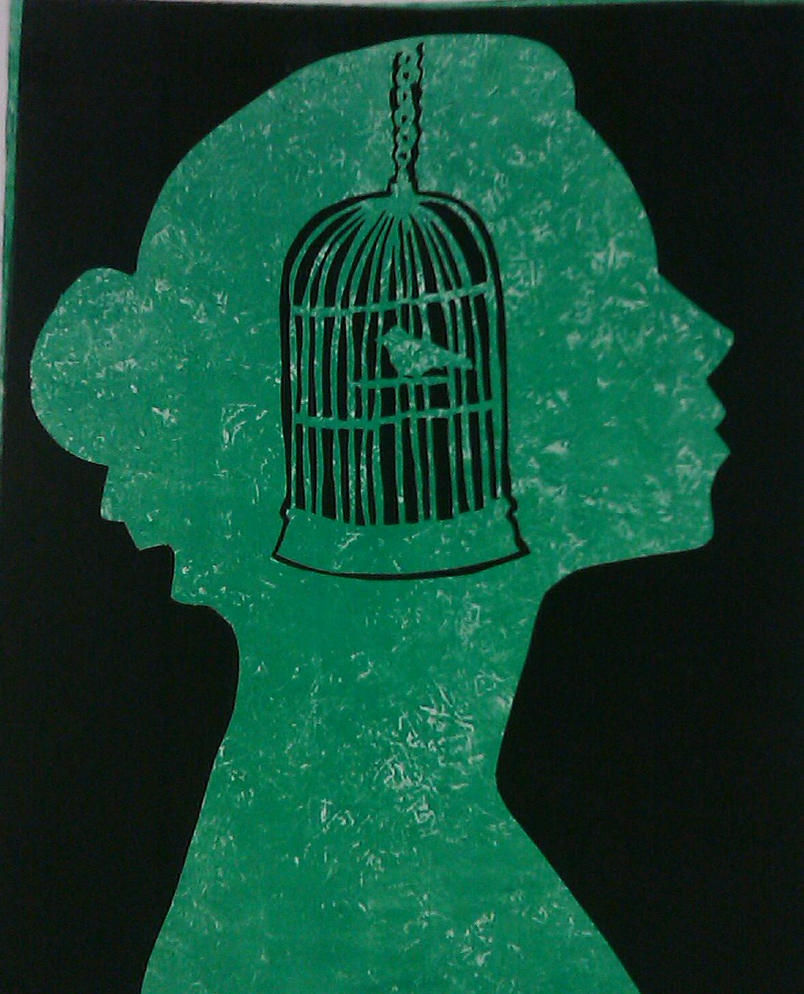
Throughout the entire story Edna was seen as a caged bird. Her end was characterized by the fluttering exhaustion of a bird with a broken wing. Edna knew she would always remain a caged domesticated bird if she had lived. 


Thursday, December 3, 2015

The Awakening (Post #4)


"He did not know; he did not understand. He would never understand." (176)

The irony in Edna’s final thoughts before she commits suicide is rather comical. All throughout The Awakening Edna was a naïve character. She didn’t understand her feelings for Robert until she left. She didn’t understand that Robert loved her back. She probably didn’t even understand that her feminist actions were improper and would lead to repercussions. However in nature of being a dynamic character, Edna changes. In the short time before her suicide, Edna finally understands how confined she really is. Edna would rather keep her “body and soul” (176) over being in a relationship with the man she loves. In order for Edna to truly have control over her life, she understands that she has to take it away.

The last part of the book really focuses on Edna’s true awakening from a naïve girl to an experienced woman. Chopin uses very specific diction in order to capture how different Edna is from the rest of her society. Edna witnesses Madame Ratignolle “with a flaming, outspoken revolt against the ways of Nature” (170). It was the very nature of women to have children during the time period, yet watching her friend give birth gives Edna “inward agony” (170). Edna’s suicide itself though is very anti-climatic. Edna simply sinks while there is “the hum of bees and the musky odor of pinks” (176). Chopin may be suggesting that while Edna’s suicide is a major decision for Edna, it ultimately doesn’t stop the nature of things from continuing. However drowning was a very common way for Victorian women to commit suicide. Chopin, through Edna, could also be alluding to the deaths of actual Victorian women who committed suicide by drowning themselves.

Wednesday, December 2, 2015

The Awakening (blog #4)

In The Awakening, Edna says, “[P]erhaps it is better to wake up after all, even to suffer, rather than to remain a dupe to illusions all one’s life” (171). This quotation accurately portrays Edna’s situation and choices throughout the story.
Edna awakens from her unhealthy marriage in the beginning of the book. She realizes how Mr. Pontellier causes “an indescribable oppression… [to fill] her whole being” after spending her summer at Grand Isle (49). She admits that previously “the abundance of her husband’s kindness and [his] uniform devotion” blinded her from his controlling behaviors (49). After opening her eyes and understanding the reality of her marriage, she breaks free by purchasing her own house. Despite “[descending] in the social scale,” she “[rises] in the spiritual [scale]” and “[expands] as an individual,” which leads to her so-called freedom and happiness (151).
Towards the end of the story, Edna awakens once more with the help of Madame Ratignolle. Edna continues to live in an illusion as she believes she has full control over her life: she is “no longer one of Mr. Pontellier’s possessions” (167). She naively confesses to Robert, “We shall be everything to each other. Nothing else… is of any consequence” (168). However, Madame Ratignolle drags Edna out of her fantasy by reminding her to “think of [her] children” (170). Her children are her “antagonists” who prevent her from obtaining true freedom (175). As a result, by waking up from her delusion, Edna is able to obtain complete independence by committing suicide. She becomes “some new-born creature” during the process (175).

3a365972e98594a44eb40e8a2e6b3569.jpg

Unlike Edna, who believes “waking up” conquers all, Daisy believes “remaining a dupe” shields a girl from severe hardships. Is it better to be aware of reality or be oblivious to the world?

Friday, November 27, 2015

The Awakening Post #3

Throughout the course of the story, Edna Pontellier shows herself being immature and selfish. Edna’s relationship with Robert is like a school girl crush; her eyes were emerald green when Robert was talking to Mariequita. Edna saw her as competition and “she looked Mariequita up and down, from her ugly brown toes to her pretty black eyes, and back again” (Chopin 81).Edna, a married woman, is selfish. Edna has a doting husband at home, yet she is worried about having another man all to herself. When Edna’s affairs began, she only thought about herself. She was thoughtless, oblivious to the fact that there would be negative consequences when she was caught. Her marriage, children, and reputation were on the line. Edna was already seen as an outsider to the Creole community; her adulterous behaviors would place her in exile and ruin any foreigner’s chance for a relationship with a Creole man.

Edna’s immaturity is most prevalent with her children. Mothers are supposed to care for their children and are even willing to die for their children. Edna struggled when doing either. “Edna had once told Madame Ratignolle that she would never sacrifice herself for her children” (Chopin 97). Children are supposed to help people become more responsible, but it didn’t work for Edna. Edna’s immaturity and selfishness could be partly due to the fact that women were married and had children at a younger age, compared to their husbands marrying at an older age. Edna does not think about the impact of her actions and her carelessness will lead to most of the problems she will later face.

The Awakening Post 3


The Awakening is full of gender equality issue that many of us have already blogged about, yet I can’t seem to get over the way Colonel talked about Edna. “Authority, coercion are what is needed. Put your foot down good and hard; the only way to manage a wife. Take my word for it.” (125)  Colonel tells Léonce that this is how he should be treating his daughter. The first two sentences are insulting enough to Edna, imply that she needs to be controlled and “managed” to be considered a good wife. The word choice was extremely harsh almost as if referring to Edna as a type of animal who needs to be managed.

When analyzing the last sentence of the quote “Take my word for it.” I began to think on what if Edna’s urge for independence wasn’t all that sudden. While Colonel makes it clear to Léonce that he controls Edna’s mother, it’s also easy to infer that Edna grew up watching her mother be bossed around by a man. Since in the beginning of The Awakening Edna always made references to the bird in the cage symbolizing that she feels trapped in her own life. We might be able to infer that she knew all along that she didn’t want to be like her mother.


The picture above is from the movie The Titanic, this is taken from the scene when rose is telling her mother that she does not want to marry the rich man, and act like the high society wife that her mother portrayed although she was unhappy. While the titanic was about Rose no longer caring about social status and being true to herself and being with not wealthy jack. I find the relation in The Awakening from Rose finds independence by doing what she truly wants not what her mother tells her to do. Just like Edna finds independence from becoming a woman who is not the housewife and not the woman who is controlled by her husband even though that’s how she was raised and that’s how she saw her mother get treated.

Blog Post #3


As the novel progresses, it becomes apparent how emotionally immature Mrs. Pontellier truly is. She confuses feelings of lust for love, jealousy for annoyance, and flriting for romance. When Mrs. Pontellier notices Robert's affectionate "puppy manner" towards her friend, she proclaims that she is "glad he had not assumed a similar role toward herself. it would have been unacceptable and annoying" (pg ). Mrs. Pontellier claims to not want the attention of Robert but continued to show signs of jealousy when he ignores her. Mrs. Pontellier believes that what she feels is annoyance when Robert tries to talk to her, when in actuality she enjoys it. She is not in tune with her emotions and has no idea how to decipher what she is truly feeling. 
This meme relates back to The Awakening from a comical standpoint. Though it does not literally represent emotional confusion in the same way as Chopin, it depicts a woman of many mixed emotions. This relates to Mrs. Pontellier because she in not sure what she is feeling at any given moment. However, Mrs. Pontellier does not realize she is wrong about her feelings; the readers pick up on her emotional immatruity but she clearly does not. 
Mrs. Pontellier further demonstartes her lack of intuitive with her own emotions when she allows Robert to rest his head on her shoulder. She said earlier in that novel that she would be annoyed, but contradicts herself by allowing it. Mrs. Pontellier is similar to an immature teenage girl with how drastic her change in emotions is. It shows her lack of exposure and lack of life experience. 

The Awakening Post #3

      Throughout the book there are several inferences to birds. Chopin uses birds as extended metaphors that refer to Edna. The novel opens with a screaming parrot, whose Spanish was only understood by the mocking-bird. The frustrated parrot may represent Edna, who is trapped and like the parrot has no voice in worthwhile matters. Parrots can only repeat what they hear and in the beginning of the story Edna chose to follow along with the other house wives. The understanding mocking-bird is Mademoiselle Reisz. Reisz serves as Edna's confidant; "the woman, by her divine art, seemed to reach Edna's spirit and set it free (Chopin 133). Edna is often referred to as a caged bird. As a victorian woman she is trapped inside her very own gilded cage. In fact, even when Edna moves into the pigeon house, she is still trapped. Her ever-present loneliness can only be quelled by lustful intimacy with Alceé. Mademoiselle Reisz also metaphorically takes notice of Edna's "wings". Reisz examined Edna's shoulder blades to see if her wings were strong enough to "soar above the level plain of tradition and prejudice" (Chopin 138). She was then warned that only those who were strong enough could complete the journey and not become too "exhausted" (Chopin 138) and flutter back down to Earth. Reisz's comment alludes to the legend of Icarus. Icarus met his death when his manufactured wings melted due to his overconfidence. This could possibly be foreshadowing Edna's outcome, or simply stand as a warning. Birds overall signify freedom-whether Edna has it or not. Once while Mademoiselle was playing the piano, Edna envisioned wild birds taking flight. Caged birds remind Edna of her entrapment while birds in flight signify the freedom Edna yearns for.

The pigeon as a symbol

    Edna's new apartment is referred to as the "Pigeon house" (Chopin 140). She claims that the reason for this is because of its size but it could also be that she is the pigeon. Doves and pigeons are interrelated species but their connotations are very different. Doves are considered to be very pure, while pigeons are seen as dirty. Edna can no longer be considered a dove because she has committed adultery. If anyone is to find out about Edna's sins her reputation will suffer. Pigeons are also domesticated creatures. Although Edna has strayed from her husband she is still viewed as a domesticated Victorian woman.

Wednesday, November 25, 2015

The Awakening (Post #3)


“There was her husband’s reproach looking at her from the external things around her which he had provided for her external existence. There was Robert’s reproach making itself felt by a quicker, fiercer, more overpowering love, which had awakened within her toward him.” (139)
After Alcée kisses her, Edna cries a little and thinks about two of the men in her life. She may not realize it, but Edna essentially has to choose between duty, passion, and love.
Léonce is the path of duty. If Edna stays with him, she can keep her reputation in the Victorian society at the cost of her happiness. In order to be happy, Edna moves away.  Léonce only wants Edna back from her pigeon house because of his “financial integrity” (138). This really shows that superficial reputations are more important than true love in the Victorian society.
Robert is the path of love. Mademoiselle Reisz tells Edna that Robert “loves [her], and is trying to forget [her]” (135) since she is a married woman. In another post, it was mentioned that Robert and Edna are star-crossed lovers. Being star-crossed lovers, Edna’s marriage probably won’t stop their love. Yet there is one more player in the game for Edna’s heart.
Alcée is the path of lust. He seems to prey on Edna’s emotional distress like an incubus. After Edna’s dinner party when she was “chilled, and miserable” (149), Alcee did not leave until Edna “had become supple to his gentle, seductive entreaties” (151). Although she loves Robert, this act of adultery proves Alcée holds a place in Edna's life.
Based on what happens to Juliet Capulet and Hester Prynne, it’s possible that even with three men to choose from, Edna Pontellier will either commit suicide or continue to live with a child born out of adultery.


The Awakening (blog #3)

The pigeon-house symbolizes Edna’s breakthrough as an individual. She purchases the house using her own money: money from her mother’s estate, money from winning races, and money from selling her sketches. By buying the house with her own finances, Edna no longer relies on Mr. Pontellier as money is the only thing he ever provides her. He does not supply her with feelings of love nor with feelings of happiness. The pigeon-house gives Edna a “feeling of freedom and independence,” “a feeling of having descended in the social scale, with a corresponding sense of having risen in the spiritual” (134, 151).
Outsiders attempt to dissuade Edna from living in her pigeon-house and experiencing independence. For instance, Madame Ratignolle relates Edna to “a child,” a person who acts “without a certain amount of reflection” (153). She believes Edna is being irresponsible for choosing to live by herself. Arobin, despite supporting her breakthrough, terms Edna’s departure from Mr. Pontellier’s house as a “coup d’état” (141). The word tends to seem negative as it correlates to treason. Mr. Pontellier even makes an effort to mask Edna’s newfound freedom from the public by notifying one of the daily papers that “their handsome residence on Esplanade Street… would not be ready for occupancy until their return [from their summer sojourn abroad]” (151). He creates a new situation to hide the truth.
Ironically, a pigeon house is used to constrain pigeons. While Edna’s house is only called the “pigeon-house” for being “so small” and looking "like a pigeon house,” perhaps the pigeon-house will foreshadow the ending of the book (140). The pigeon-house could symbolize her freedom from Mr. Pontellier but not her freedom in society.

Saturday, November 21, 2015

The Awakening Post #2

Chopin's characterizations in the Awakening propel the story. Robert is the foil of Leonce Pontellier. The only similarity both Robert and Mr. Pontellier share is they are both higher up on the social ladder. Robert smokes cigarettes, Mr. Pontellier smokes cigars. Robert is a flirtatious man; Mr. Pontellier is devoted to his wife and children. Robert has the attention of Edna Pontellier; Edna Pontellier evinced so little interest in things which concerned him (Mr. Pontellier), and valued so little his conversation. Robert has made Edna’s boring life of a “mother woman” interesting. Unlike Mr. Pontellier, Robert sparked something inside Edna. Robert sparked a mental and sexual rebirth in Edna that Mr. Pontellier killed. Others were aware of the competition for Edna’s heart between Mr. Pontellier and Robert when a woman told Robert “She (Edna) might make the unfortunate blunder of taking you seriously.”(Chopin 64)

Like the article states, women cheat due to being unhappy in relationships and unsatisfied. All Mr. Pontellier could solicit from Edna were tears and built up feelings of aggression. Married women cheat to find something to make their heart race again, and to add excitement to their unhappy lives. Robert gave Edna Pontellier something new and exciting that she had never done before. Mr. Pontellier was a useless, boring husband whom Edna only married for financial stability; Robert was a fun,flirty bachelor. Edna's exciting life began after her first swim. When Robert spoke to her later that night, she did not respond. “No multitude of words could have been more significant than those moments of silence, or more pregnant with the first felt throbbings of desire."(Chopin 77) An affair is bound to begin.

Friday, November 20, 2015

The Awakening Post 2 (possible spoiler)(so sorry)


All throughout the book it’s clear that gender expectations plays a huge role in the theme. During the Victorian era typically women were housewives, if possible to even classify them as that. Women were solely important for reproduction and status. Women were objectified during this era. As remarks throughout the story would support, "You have been a very, very foolish boy, wasting your time dreaming of impossible things when you speak of Mr. Pontellier setting me free! I am no longer one of Mr. Pontellier's possessions to dispose of or not. I give myself where I choose.” (150)  Edna says this to explain to Robert that she not just something Léonce can give away because he wants to, she is a someone and she decides how her life goes.
 Also reflecting back to when Edna began to swim she said “A feeling of exultation overtook her, as if some power of significant import had been given her to control the working of her body and her soul. She grew daring and reckless, overestimating her strength. She wanted to swim far out, where no woman had swum before.” (70) She felt just in this moment for the first time that she had power over her body and soul and she only felt this way because she was the only one who could swim for herself, she was the only person keeping her afloat no one else could do it for her. Edna first experience with independence in a weird sense, opened her eyes to the fact that she should always be in control of herself, and allow no one (man) dictate her actions.

The Awakening Post # 2

        Adele Ratignolle represents the ideal house wife and mother during the victorian era. In the beginning Edna placed her on a pedestal and sought to emulate her ideals. However, as Edna begins to venture into self reliance, the distance between her and the creole housewife becomes evident. It is in this way that she acts as a foil to Edna. As the story progresses their stark contrast grows even larger. Edna is starting to seriously consider art- career wise, while Madame Ratignolle sees her music as an outlet to further serve her family. After dinner with the Ratignolles Edna realizes that she will never be satisfied with a life as conventional as theirs is. Madame Ratignolle exists only to serve others. Her "blind contentment" appalls Edna, for she will never know of "life's delirium" (Chopin 107). Edna's desires lie in individuality and she herself admits to this when she confesses to Adele that she would not entirely give herself up,  even at the expense of her children.

       In the meantime Edna grows closer to Mademoiselle Reisz. Reisz is a self sufficient pianist who's passions are not hidden for fear of judgment. Edna yearns to be a woman in tune with her emotions the way Reisz is. By growing closer to her, Edna realizes she is capable of harnessing such ardent feelings. Though financially and emotionally stable, Reisz's life lacks warmth. She lacks the support of friendships and the intimacy of a relationship. Reisz serves as an even more blatant foil to Madame Ratignolle. Reisz lives in complete autonomy, yet her life lacks warmth, while Ratignolle lives as a servant to her home, but has a successful marriage. Their extreme distinctions demonstrate how Edna wants to fall somewhere in the middle. Edna seeks to evade Madame Ratignolle's "colorless existence" (Chopin 107) but is fearful of Mademoiselle Reisz's solidarity. Reisz is an independent women but she is alone. Ratignolle is ignorantly blissful at home with her husband but has unknowingly caged herself in. Edna yearns for her lover Robert, but also her spiritual and monetary independence. The usage of foils throughout the story further enhance Edna's "awakening." Ratignolle represents Victorian ideals while Reisz represents feminist ideals. The reader is able to appreciate Edna's transition by being introduced to these characters.
       

Thursday, November 19, 2015

The Awakening (Post #2)


In Kate Chopin’s, The Awakening, feminism is clearly expressed through Edna’s independence. However, Chopin uses other characters in this novel as a contrast to Edna’s behavior in order to emphasize how unaccepted being a feminist was during that time.
Madame Ratignolle is the epitome of a Victorian woman. She and her husband are in a relationship with “domestic harmony” (Chopin 107). Edna even acknowledges that her friend “[doesn’t] leave the house, except to take [languid walks] with her husband after nightfall” (Chopin 130). Edna is always doing something- whether she is going to the races or visiting her friends- and when she is at home doing nothing, she is unhappy. The contrasting qualities between these two women show how different Edna really is from the rest of the Victorian society.
On the other hand, Mademoiselle Reisz shares many similar qualities with Edna. They are both strong willed women who wish to be left to their own devices. Mademoiselle Reisz, unlike Edna, is shunned by society. She lives alone (no husband or children), and she doesn’t really associate with anyone, save for Robert and Edna. Mademoiselle Reisz serves as a symbol of what happens to women when they choose themselves over having a husband and children.
Léonce Pontieller symbolizes the male opposition to the feminist movement. He will only be a “courteous husband so long as he [meets] a certain tacit submissiveness in his wife” (Chopin 108). Léonce goes to the doctor to ask if Edna is sick because “she’s got some sort of notion in her head concerning the eternal right of women” (Chopin 118). Besides Madamoiselle Reisz, the rest of Edna’s companions aren’t so accepting of feminism. Immersed in a society that shuns female independence, Edna’s feminist ideals will soon prove to be catastrophic for her.

Wednesday, November 18, 2015

The Awakening (blog #2)


Star-crossed lovers are commonly found in literature. For example, Hester and Dimmesdale, Romeo and Juliet, and Gatsby and Daisy all represent archetypal star-crossed lovers. They love one another deeply, but fate forbids them from being together. In The Awakening, the readers recognize Edna and Robert as a pair of star-crossed lovers.
Edna and Robert cannot openly express their affections towards one another. While Edna admits to her “incomprehensible longing” for Robert, Robert never states his love for Edna (Chopin 105). However, the readers infer that Robert reciprocates Edna’s feelings through his actions, his apparent attachment to Edna at Grand Isle. Edna, on the other hand, is a married woman, and Robert is just a young man. As a result, the two must suppress their love for one another as a married woman cannot be in love with someone other than her husband. When Edna visits Madame Lebrun and reviews Robert’s two letters, her “despondent frame of mind” overtakes her again as Robert does not mention her in his letters to his family (Chopin 112). Yet, when Robert writes a letter to Mademoiselle Reisz, the letter “might as well have been sent to [Edna]” (Chopin 114). He only asks Mademoiselle Reisz about “Mrs. Pontellier… Mrs. Pontellier… Mrs. Pontellier” (Chopin 115). Robert is unable to ask about Edna in his letters to his family without seeming suspicious. However, he can ask Mademoiselle Reisz, a despised recluse, about Edna because Mademoiselle Reisz would not broadcast his feelings to the public.
The authors of The Awakening, The Scarlet Letter, Romeo and Juliet, and The Great Gatsby not only incorporate the same archetypal star-crossed lovers in their plot, but they also separate their lovers similarly: their ill-fated lovers cannot remain together due to society.

Friday, November 13, 2015

The Awakening Post 1

In The Awakening, Kate Chopin writes using extremely descriptive language in order to induce certain feelings and subliminally let the readers in on underlying situations. By making use of this figurative language, Chopin is able to describe the attraction between Mrs. Pontellier and Robert in a way that cannot be easily picked up.
Chopin narrows in on romanticizing Robert's features--particularly his eyes and lips. "His eyes gathered in and reflected the light and languor of the summer day." She emphasizes the glistening affect they have and use the beauty of nature to enhance the beauty of how he looks. The use of imagery here allows the reader to imagine how beautiful Robert is and how refreshing he is to Mrs. Pontellier--similar to a beautiful summer day.
Chopin later goes on to describe Robert smoking--"Mrs. Pontellier reached over for a palm-leaf fan...and began to fan herself, while Robert sent between his lips light puffs from his cigarette" (Chopin, 46). Chopin is sexualizing an, otherwise, everyday scene by zoning in on the sensuality of Mrs. Pontellier fanning herself and the delicacy of Robert smoking. The language, focusing on Robert's lips, sets an intimate tone and foreshadows future events to come. Chopin is able to hint at future affairs between the two in a more censored form.
The overall use of figurative language within the passage was extremely effective in introducing the motive of the two characters, as well as, to foreshadow events to come between the two of them (as well as between Mrs. Pontellier and other men).


The Awakening: Post 1


"For men, love was important, but for women, it was absolutely necessary. As a 19th century book states: "Man's nature leads him forth into a struggle and bustle of the world. Love is but the embellishment of his early life, or a song piped in the intervals of the acts...But a woman's whole life is a history of the affections. The heart is her world.""  (http://www.thehistorybox.com/ny_city/society/articles/nycity_society_courtship_article0038.htm)
An article about Victorian Era Relationships clearly explained what the ideal, and what most women were like during this century. While most things were out of the women's hands and into her parents hands to determine their lives, most women enjoyed the idea that their biggest role in life was to get married and reproduce. Which is what causes such an unsettling feeling with Léonce about Edna. Most men just like Léonce looked at marriage and having a family as the most important part of causing and fulfilling a women's life just the quote suggest by saying “the heart is her world".

 
After Léonce asks Edna to check on their son, and she begrudgingly does, you feel the shift in a negative way on how he looks at Edna. Then it becomes clear when he begins to talk about how Edna does not have the qualities that a "mother- woman" (19) should have. Edna does not appear to be one of the women that "idolized their children, worshiped their husbands, and esteemed it a holy privilege to efface themselves as individuals and grow wings as ministering angels." (19) Léonce was addressing the fact that Edna is different, and is breaking the rules of how to be a traditional woman. While Léonce clearly wants the typical Victorian Era women he is married to the woman who just from the beginning and the small but structured actions she takes in the story that she will be one who defies the outline given by the society about how a woman should be.

The Awakening Post #1

During the Victorian Era, women were homemakers; the only things men thought women could successfully do were have children and take care of the home.“Mrs. Pontellier was not a mother-woman” (Chopin 19). In the Awakening, there is a lack of naming Mrs. Pontellier’s children. The children were referred to as “they” and “them”. Taking care of her children was a chore. Mrs. Pontellier seemed to view her children as a tedious job that she had to do. Mrs. Pontellier came to the realization of her true thoughts of her children when the children had left to meet their grandmother Pontellier in Iberville. “It seemed to free her of a responsibility which she had blindly assumed and for which Fate had not fitted her.”(Chopin 48) The “chore” of being a mother was something that Mrs. Pontellier was not fond of; she loved her children, yet sometimes the phrase “out of sight, out of mind” applied to her when dealing with her children.
The only time when a child’s name was used was when a situation revolving around the child elicited negative feelings from Mrs. Pontellier. After checking on Raoul due to Mr. Pontellier claiming he had a fever, she checked on the boy, returned back to her bedroom, and ignored her husband. She cried uncontrollably and inexplicably. These “bundles of joy,” along with her marriage, are the reasons for Mrs. Pontellier’s unhappiness. Being a mother, is prison for Mrs. Pontellier. Mrs. Pontellier doesn’t want to continue to live the mundane life of a mother-woman. The thought of being oppressed by motherhood “filled her whole being with a vague anguish.”(Chopin 14)

The Awakening (Post #1)


     "A feeling of exultation overtook her, as if some power of significant import had been given her to control the working of her body and her soul" (Chopin 73). Edna's first swim symbolizes the beginning of her independence. The accomplishment of overcoming a life long fear made Edna aware of her own self-reliance. Like any venture, the contingencies are made clear when she fears she swam out too far. Edna realizes that with her new found independence she must muster the strength to return to the shore on her own.

      Edna continues to test out her new found "power" (Chopin 73) when she defies Léonce for the first time in their marriage. She even rebukes his earlier comments and warns that next time she will not dignify him with a response. "Her will had blazed up" (Chopin 78) in that moment, and she even wondered why she had been so submissive in the past. Though in the end, Edna does end up retiring to her bedroom, her desire for freedom was made apparent for the first time. Furthermore, the swim marks the beginning of Edna and Robert's relationship. The silence the two shared while waiting for Léonce was permeated with the "throbbings of desire" (Chopin 77). It should also be noted that it was Robert who gave Edna swimming lessons, this depicts Robert as the origin for her resulting audacity.  Edna not only swam out into the ocean but into the depths of her new found independence. 


In public beaches, women would have to change in "bathing machines" that were wheeled out to the edge of the water so that women would not have to walk from the shore to the water in only their bathing suits. The Creoles in "The Awakening" were probably on a private area that did not require these machines. The men however had the freedom to bathe as they please and could even do so in their drawers. This again points out the disparity among both genders. Any sort of outward sexuality was looked down upon, which makes Edna's transformation and her later affair that much more critical. 

Thursday, November 12, 2015

The Awakening (Post #1)

“She is not one of us; she is not like us. She might make the unfortunate blunder of taking you seriously” (Chopin 64).  Madame Ratignolle, who is supposedly one of Edna’s friends, acknowledges that Edna doesn’t fit in with their society. These thoughts only continue when Edna admits she would “never sacrifice herself for her children, or for any one” (Chopin 97).
While Edna’s refusal to sacrifice herself to anyone hints at her inner strength, she is still terribly naïve. She denies her husband’s command to go into their cottage, yet she can’t understand that Robert is trying to be more than a friend. Not only does Edna not realize Robert is flirting with her, but she also doesn’t comprehend her own feelings towards him. It takes Robert leaving for Mexico in order for her to recognize “anew the symptoms of infatuation” (Chopin 94). 
Although this picture is rather crude, it does explain what happens to something when it is naïve. In Edna’s case, her throat won’t be ripped out, but she will suffer consequences. Edna will clash with her husband, her friends, and the society she has immersed herself in.
However, to reiterate an earlier point, Edna is a strong character.  Already she is resisting her husband and gaining power as a woman. Strength, while a good characteristic to have, never meshes well with naivety. Hopefully when Kate Chopin chose the title, The Awakening, she was referring to more than Edna’s strength and freedom. In order for Edna to deal with the backlash the Creoles will give her, she needs to be strong and experienced. She is pushing her husband away, and with Robert in Mexico, this could potentially lead to Edna facing the backlash alone.

The Awakening (blog #1)

Kate Chopin’s stylistic choice for The Awakening’s point of view aids the readers in comprehending the novel. Her decision to write in third person omniscient allows the readers to detect an underlying conflict between Léonce Pontellier and Edna Pontellier. Their marriage seems ideal to a majority of the characters. For example, Mr. Pontellier is deemed “the best husband in the world” by the other ladies (Chopin 50). However, the relationship is extremely disproportioned: Mr. Pontellier harbors more feelings of love towards Edna than Edna does for Mr. Pontellier. He worships her like “a valuable piece of personal property” while she notices her “symptoms of infatuation” for Robert (Chopin 44, 94). Since the readers are able to view the characters’ internal thoughts, they recognize Edna’s dissatisfaction with Mr. Pontellier and Mr. Pontellier’s one pet peeve towards Edna. Edna feels “an indescribable oppression” as she listens to every command of Mr. Pontellier (Chopin 49). Mr. Pontellier regrets Edna’s lack of “duty toward their children” (Chopin 50).
Neither of the characters vocalize their issues to one another aloud, which also establishes dramatic irony within the story. The readers perceive Edna’s lack of love for Mr. Pontellier despite his obliviousness to her romantic paucity. She admits to her marriage being “purely an accident” (Chopin 62). She fancies “his absolute devotion” she receives from him; she does not fancy him in general (Chopin 62). Unaware of Edna’s true feelings, Mr. Pontellier unintentionally induces Edna to gain feelings for Robert by allowing her to spend time with him alone.
These hidden thoughts of the Pontelliers potentially foreshadow future marriage conflicts in The Awakening.

Sunday, November 8, 2015

Let's start blogging!

Welcome to our AP Lit & Comp reading blog for The Awakening by Kate Chopin.  This blog serves as a discussion space for all students reading The Awakening across all three class sections.  The end goal is for us to build a reading community both online and within the classroom.  In addition, many college courses will require online work and postings for all of your peers to view and comment on a weekly basis.

Girl Seated by the Sea, Rober Henri (1893)

What do we blog about?

Well, we're all reading the same novel, so we don't want to summarize (as always).  Instead, you can provide brief context for what part of the novel you're discussing & use examples from the novel, but your main purpose is to have an analytical focus for each post.  Here are some things you could discuss & analyze in your blog posts:
  • Literary elements you see in the novel (think metaphors, symbols, archetypes)
  • Conflicts (how they arise, how they define characters, etc.)
  • Characterization:  
    • actions, dialogue, or lines that define a character
    • character's motivations
  • Author's style, structure, & diction
  • Close reading of diction where you're looking for clarification
  • Events in the plot that serve as a major turning point
  • How a tradition, value, or practice functions within the culture of your novel
  • Themes shown in the novel
  • How literary elements serve a theme (like race/culture relations, romantic entanglements, gender expectations)...if you can accomplish this, you've made it to the big leagues.

Things to keep in mind for this type of assignment:

  • You're writing online, but this isn't social media, which means no text-speak or slang.  Write in an academic language.
  • Use this space as practice for properly writing literary analysis (writing in present tense, avoiding 1st/2nd person pronouns, using active voice, being succinct)
  • Don't let your work disappear forever somewhere in the land of lost internet posts.  Be smart & save your work.  Some people like to work in Google Docs, MS Word, or Apple Pages first.  Then, just copy & paste all you've typed into Blogger & add some bells & whistles (i.e. pictures, links, videos)

Timeline for posting & commenting:


  • 11/13:  1st blog post due
  • 11/16:  comment on 2 posts
  • 11/20:  2nd blog post due
  • 11/23:  comment on 2 posts
  • 11/27:  3rd blog post due
  • 11/30:  comment on 2 posts
  • 12/4:  4th blog post due
  • 12/7:  comment on 2 posts
  • TOTALS:  4 blog posts & 8 comments
  • NOTE:  posts are due on Fridays by 11:59 p.m. & comments on Mondays 11:59 p.m.

Other requirements:

  • 250-300 word count
  • Add links, pictures, & videos
  • Comments should be at least 3 sentences that add or extend the post
  • Quote evidence from the novel & use proper MLA format for embedded citations