Friday, December 4, 2015

The Awakening Post #4


As stated in the article, the Creoles saw themselves as urban and sophisticated and a refined style of European living was their aspiration. The Creole community had a strong impact on Mrs. Pontellier attitudes. Mrs. Pontellier felt as though she was an outsider because she was not originally from the Creole community, and Mrs. Pontellier’s feelings proved correct when Mrs. Ratignolle said “She is not one of us; she is not like us.”(Chopin 64) 

Perhaps Mrs. Pontellier’s sprouting feelings of anger and oppression were not caused by her marriage with Leonce, but due to the fact she is looked down upon in a community that is newer to her.  A person can only take being ignored or disrespected for so long before they will feel frustrated and upset.  Mrs. Pontellier begins to dislike Leonce because he is her direct link to the Creole community. If she unlinks herself from Leonce, then she will not have to be near the people that solicit her negative emotions. Her feeling of discrimination could be the reason that Mrs. Pontellier attached herself to Robert. Even though Robert was popular throughout the Creole community, he still treated Mrs. Pontellier how he treats others, and eventually he even feel in love with her. Robert shows how he is different from other members of the Creole society by saying “I hope she has discernment enough to find in me something besides the blagueur. If I thought there was any doubt- “(Chopin 64) Robert’s attitude of treating everyone the same made him standout to Mrs. Pontellier.

Blog Post #4

     Edna's romantic expectations concerning Robert add to her naivety as a character. She has unrealistic expectations for their relationship and thought that Robert would simply forget her past and see her only as the independent woman she grew to become. Robert's morals insist that he call Edna, Mrs. Pontellier. Edna is comfortable with solidifying their union through adultery, but Robert is not. Even though Robert has returned from Mexico, he is still just as unavailable to Edna. Though Edna has ceased to see herself as a possession, Robert feels that the reason they cannot be together is because Edna belongs to Leoncé. When Edna and Robert finally discuss their relationship he admits the root of the problem is ownership, and the transfer of it from Leoncé to himself. But he then goes on to describe such an act as simply "vague, [and] mad intentions" (Chopin 167). Robert is more concerned with the logistics of the relationship than his love for Edna. Edna had seen Robert as the final step towards her liberation, but in reality he would only allow her to exist within the Victorian man and wife dynamic. Edna realizes this and pokes fun at Robert's conservative views: "If [Leoncé] were to say, 'Here, Robert, take her and be happy; she is yours,' I should laugh at you both" (Chopin 167). Before Edna leaves Robert to tend to Madame Ratignolle he reveals his deeply rooted passion for Edna by begging her to stay. "Her seductive voice... had enthralled his senses..." (Chopin 168) but Robert's passions are not strong enough to further pursue Edna. Robert was forced to choose between his morality and feelings of affection. It only makes sense that Edna's last resort to achieve freedom was suicide. Whether it be Leoncé, Arobin, or Robert, she would still be confined to Victorian Social norms. Her mindset proved to be before her time and therefore she decided to relinquish herself from her shackles. 
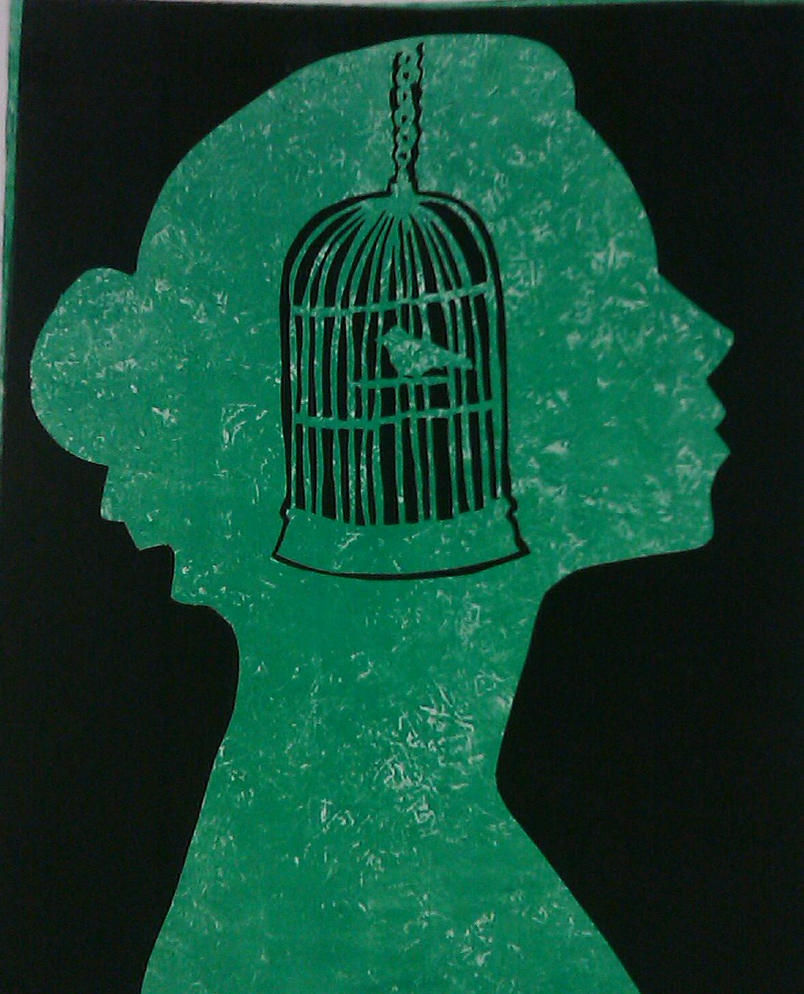
Throughout the entire story Edna was seen as a caged bird. Her end was characterized by the fluttering exhaustion of a bird with a broken wing. Edna knew she would always remain a caged domesticated bird if she had lived. 


Thursday, December 3, 2015

The Awakening (Post #4)


"He did not know; he did not understand. He would never understand." (176)

The irony in Edna’s final thoughts before she commits suicide is rather comical. All throughout The Awakening Edna was a naïve character. She didn’t understand her feelings for Robert until she left. She didn’t understand that Robert loved her back. She probably didn’t even understand that her feminist actions were improper and would lead to repercussions. However in nature of being a dynamic character, Edna changes. In the short time before her suicide, Edna finally understands how confined she really is. Edna would rather keep her “body and soul” (176) over being in a relationship with the man she loves. In order for Edna to truly have control over her life, she understands that she has to take it away.

The last part of the book really focuses on Edna’s true awakening from a naïve girl to an experienced woman. Chopin uses very specific diction in order to capture how different Edna is from the rest of her society. Edna witnesses Madame Ratignolle “with a flaming, outspoken revolt against the ways of Nature” (170). It was the very nature of women to have children during the time period, yet watching her friend give birth gives Edna “inward agony” (170). Edna’s suicide itself though is very anti-climatic. Edna simply sinks while there is “the hum of bees and the musky odor of pinks” (176). Chopin may be suggesting that while Edna’s suicide is a major decision for Edna, it ultimately doesn’t stop the nature of things from continuing. However drowning was a very common way for Victorian women to commit suicide. Chopin, through Edna, could also be alluding to the deaths of actual Victorian women who committed suicide by drowning themselves.

Wednesday, December 2, 2015

The Awakening (blog #4)

In The Awakening, Edna says, “[P]erhaps it is better to wake up after all, even to suffer, rather than to remain a dupe to illusions all one’s life” (171). This quotation accurately portrays Edna’s situation and choices throughout the story.
Edna awakens from her unhealthy marriage in the beginning of the book. She realizes how Mr. Pontellier causes “an indescribable oppression… [to fill] her whole being” after spending her summer at Grand Isle (49). She admits that previously “the abundance of her husband’s kindness and [his] uniform devotion” blinded her from his controlling behaviors (49). After opening her eyes and understanding the reality of her marriage, she breaks free by purchasing her own house. Despite “[descending] in the social scale,” she “[rises] in the spiritual [scale]” and “[expands] as an individual,” which leads to her so-called freedom and happiness (151).
Towards the end of the story, Edna awakens once more with the help of Madame Ratignolle. Edna continues to live in an illusion as she believes she has full control over her life: she is “no longer one of Mr. Pontellier’s possessions” (167). She naively confesses to Robert, “We shall be everything to each other. Nothing else… is of any consequence” (168). However, Madame Ratignolle drags Edna out of her fantasy by reminding her to “think of [her] children” (170). Her children are her “antagonists” who prevent her from obtaining true freedom (175). As a result, by waking up from her delusion, Edna is able to obtain complete independence by committing suicide. She becomes “some new-born creature” during the process (175).

3a365972e98594a44eb40e8a2e6b3569.jpg

Unlike Edna, who believes “waking up” conquers all, Daisy believes “remaining a dupe” shields a girl from severe hardships. Is it better to be aware of reality or be oblivious to the world?

Friday, November 27, 2015

The Awakening Post #3

Throughout the course of the story, Edna Pontellier shows herself being immature and selfish. Edna’s relationship with Robert is like a school girl crush; her eyes were emerald green when Robert was talking to Mariequita. Edna saw her as competition and “she looked Mariequita up and down, from her ugly brown toes to her pretty black eyes, and back again” (Chopin 81).Edna, a married woman, is selfish. Edna has a doting husband at home, yet she is worried about having another man all to herself. When Edna’s affairs began, she only thought about herself. She was thoughtless, oblivious to the fact that there would be negative consequences when she was caught. Her marriage, children, and reputation were on the line. Edna was already seen as an outsider to the Creole community; her adulterous behaviors would place her in exile and ruin any foreigner’s chance for a relationship with a Creole man.

Edna’s immaturity is most prevalent with her children. Mothers are supposed to care for their children and are even willing to die for their children. Edna struggled when doing either. “Edna had once told Madame Ratignolle that she would never sacrifice herself for her children” (Chopin 97). Children are supposed to help people become more responsible, but it didn’t work for Edna. Edna’s immaturity and selfishness could be partly due to the fact that women were married and had children at a younger age, compared to their husbands marrying at an older age. Edna does not think about the impact of her actions and her carelessness will lead to most of the problems she will later face.

The Awakening Post 3


The Awakening is full of gender equality issue that many of us have already blogged about, yet I can’t seem to get over the way Colonel talked about Edna. “Authority, coercion are what is needed. Put your foot down good and hard; the only way to manage a wife. Take my word for it.” (125)  Colonel tells Léonce that this is how he should be treating his daughter. The first two sentences are insulting enough to Edna, imply that she needs to be controlled and “managed” to be considered a good wife. The word choice was extremely harsh almost as if referring to Edna as a type of animal who needs to be managed.

When analyzing the last sentence of the quote “Take my word for it.” I began to think on what if Edna’s urge for independence wasn’t all that sudden. While Colonel makes it clear to Léonce that he controls Edna’s mother, it’s also easy to infer that Edna grew up watching her mother be bossed around by a man. Since in the beginning of The Awakening Edna always made references to the bird in the cage symbolizing that she feels trapped in her own life. We might be able to infer that she knew all along that she didn’t want to be like her mother.


The picture above is from the movie The Titanic, this is taken from the scene when rose is telling her mother that she does not want to marry the rich man, and act like the high society wife that her mother portrayed although she was unhappy. While the titanic was about Rose no longer caring about social status and being true to herself and being with not wealthy jack. I find the relation in The Awakening from Rose finds independence by doing what she truly wants not what her mother tells her to do. Just like Edna finds independence from becoming a woman who is not the housewife and not the woman who is controlled by her husband even though that’s how she was raised and that’s how she saw her mother get treated.

Blog Post #3


As the novel progresses, it becomes apparent how emotionally immature Mrs. Pontellier truly is. She confuses feelings of lust for love, jealousy for annoyance, and flriting for romance. When Mrs. Pontellier notices Robert's affectionate "puppy manner" towards her friend, she proclaims that she is "glad he had not assumed a similar role toward herself. it would have been unacceptable and annoying" (pg ). Mrs. Pontellier claims to not want the attention of Robert but continued to show signs of jealousy when he ignores her. Mrs. Pontellier believes that what she feels is annoyance when Robert tries to talk to her, when in actuality she enjoys it. She is not in tune with her emotions and has no idea how to decipher what she is truly feeling. 
This meme relates back to The Awakening from a comical standpoint. Though it does not literally represent emotional confusion in the same way as Chopin, it depicts a woman of many mixed emotions. This relates to Mrs. Pontellier because she in not sure what she is feeling at any given moment. However, Mrs. Pontellier does not realize she is wrong about her feelings; the readers pick up on her emotional immatruity but she clearly does not. 
Mrs. Pontellier further demonstartes her lack of intuitive with her own emotions when she allows Robert to rest his head on her shoulder. She said earlier in that novel that she would be annoyed, but contradicts herself by allowing it. Mrs. Pontellier is similar to an immature teenage girl with how drastic her change in emotions is. It shows her lack of exposure and lack of life experience.